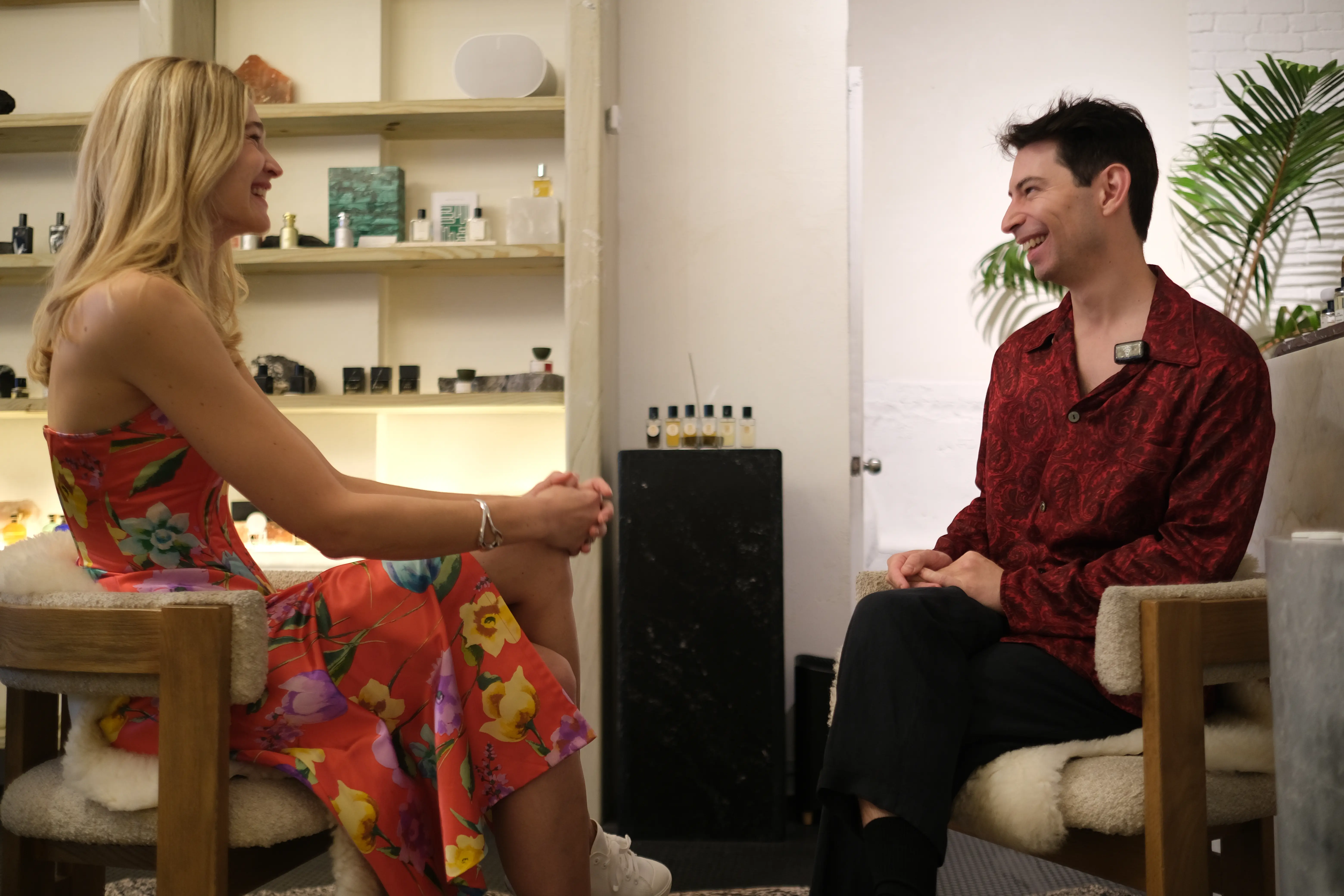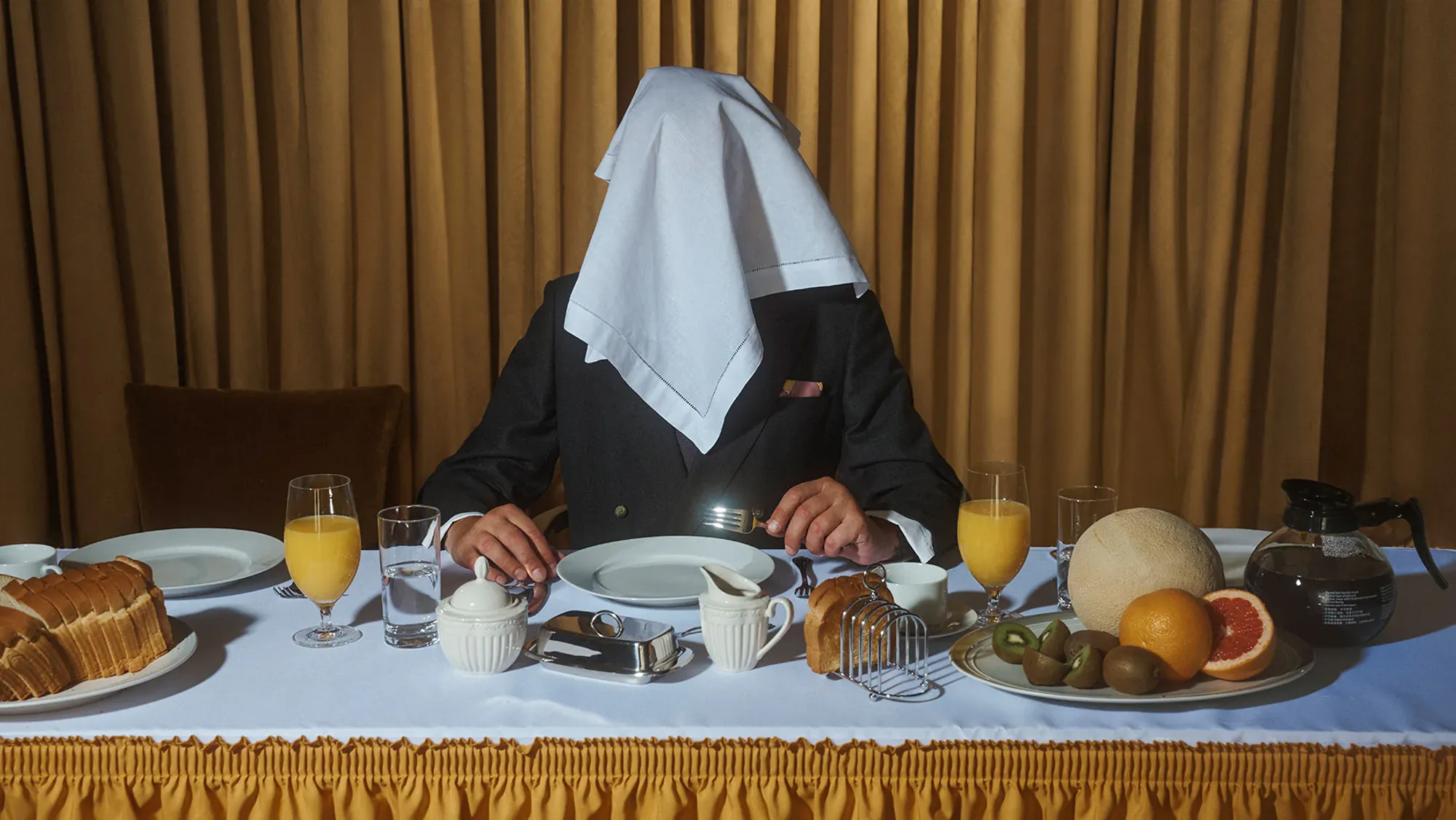
From fashion journalism at Dazed and Interview to crafting perfumes in his Manhattan studio, Trey has spent his career exploring how we signal taste, status, and identity. His brand, Serviette - named after a deliberately misused word - challenges the idea that sophistication is inherited rather than learned. With fragrances inspired by Roman senators and Victorian rituals, he’s creating a world where cultural curiosity matters more than your budget. In this conversation, he explains why “serviette” isn’t fancy, what $30,000 can really get you, and why scent remains the only sense wired directly to your brain.
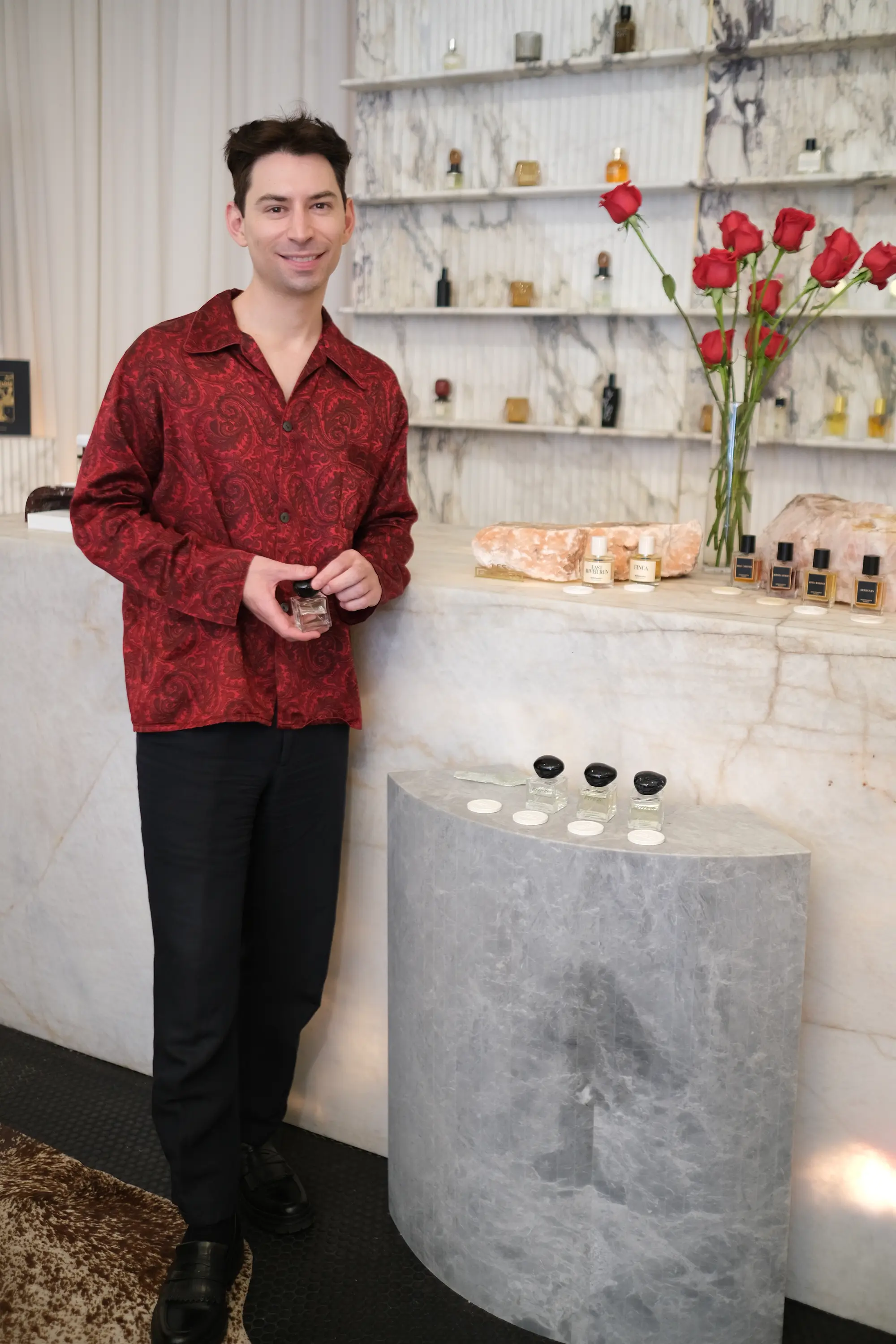
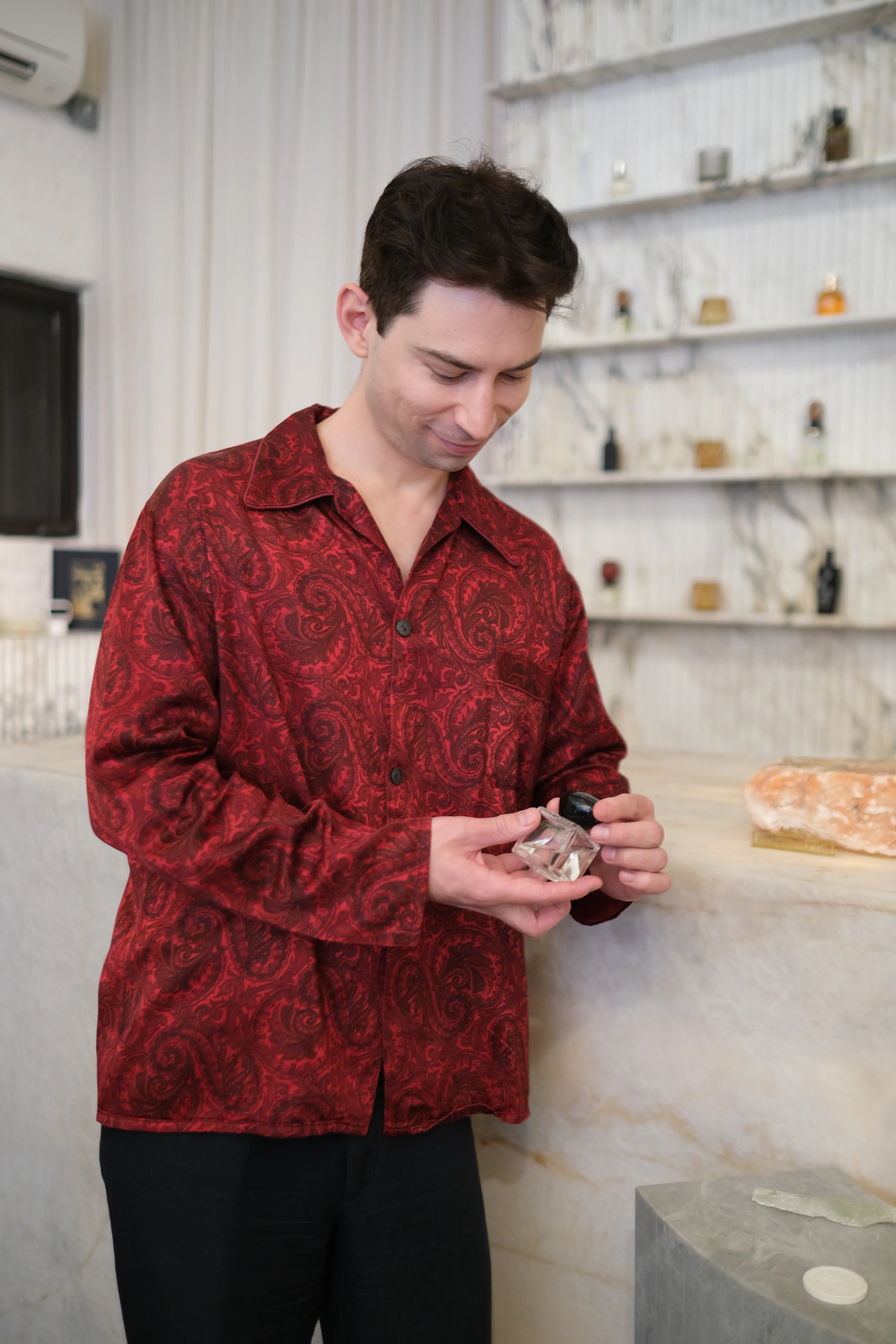
Trey holding one of his signature scents at Stéle on Mott Street in Nolita, NY, where his fragrances can be found.
The Question That Started Everything: How Do Celebrities Smell?
How did Serviette go from idea to reality?
I've always been fascinated by fashion and the power dynamics that were once apparent in glossy fashion magazines, how an editor could dictate what would be popular. That led me into journalism at Dazed, Interview, and The Face. While living in London, I was introduced to niche perfumery. I got really interested in how fragrance conveys identity, especially working in celebrity journalism.
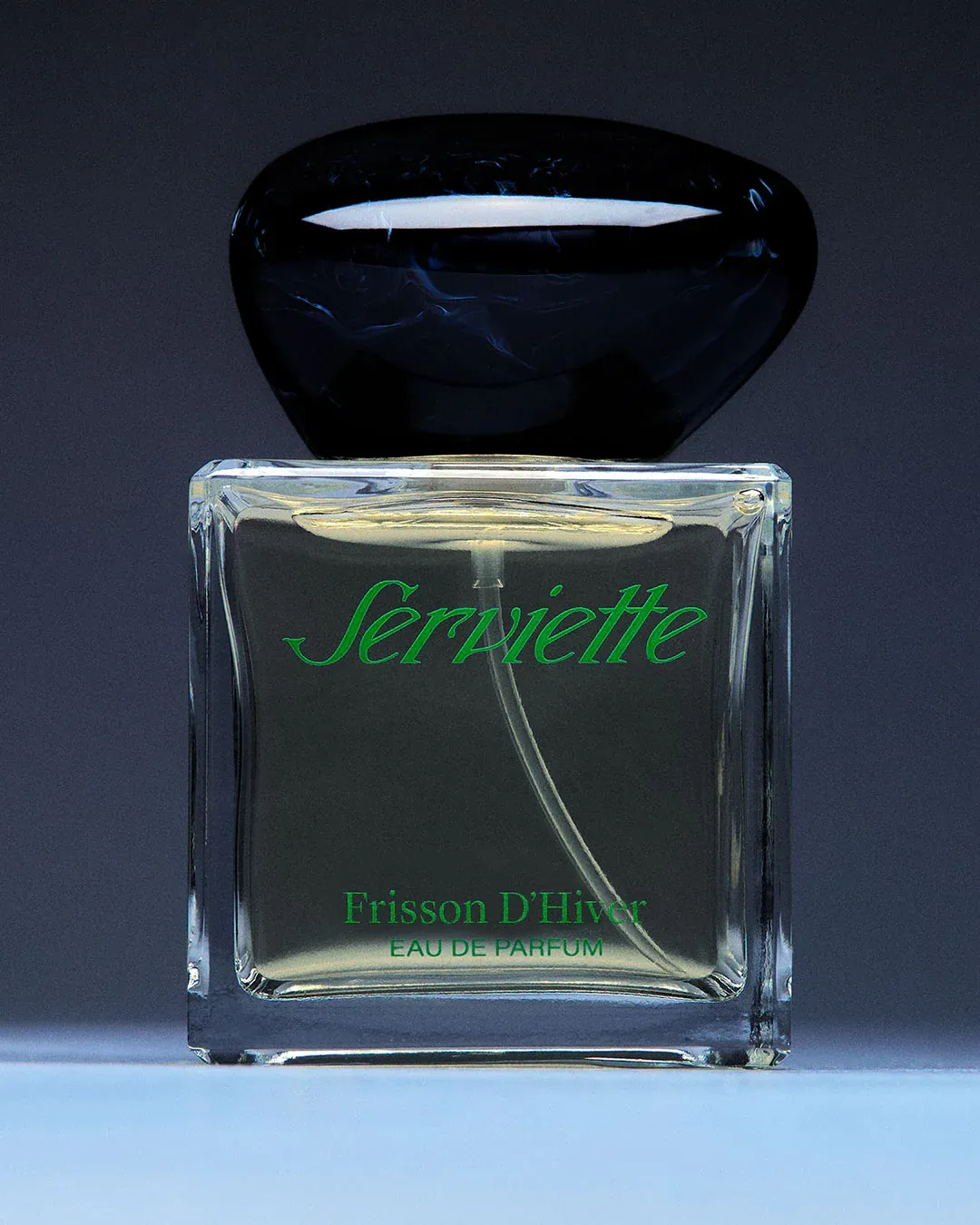
Growing up in a small town, I didn't have access to perfume, just drugstore brands. For me, fragrance was nature: the changing seasons, the smell of snow. That cold feeling is actually in one of my perfumes, Frisson D’Hiver.
The experimentation made my mind come alive. I taught myself for a year - books, videos, trial and error. Then I reached my limit and knew I needed proper guidance. That's when I contacted an independent Brooklyn perfumer to ask to be trained.
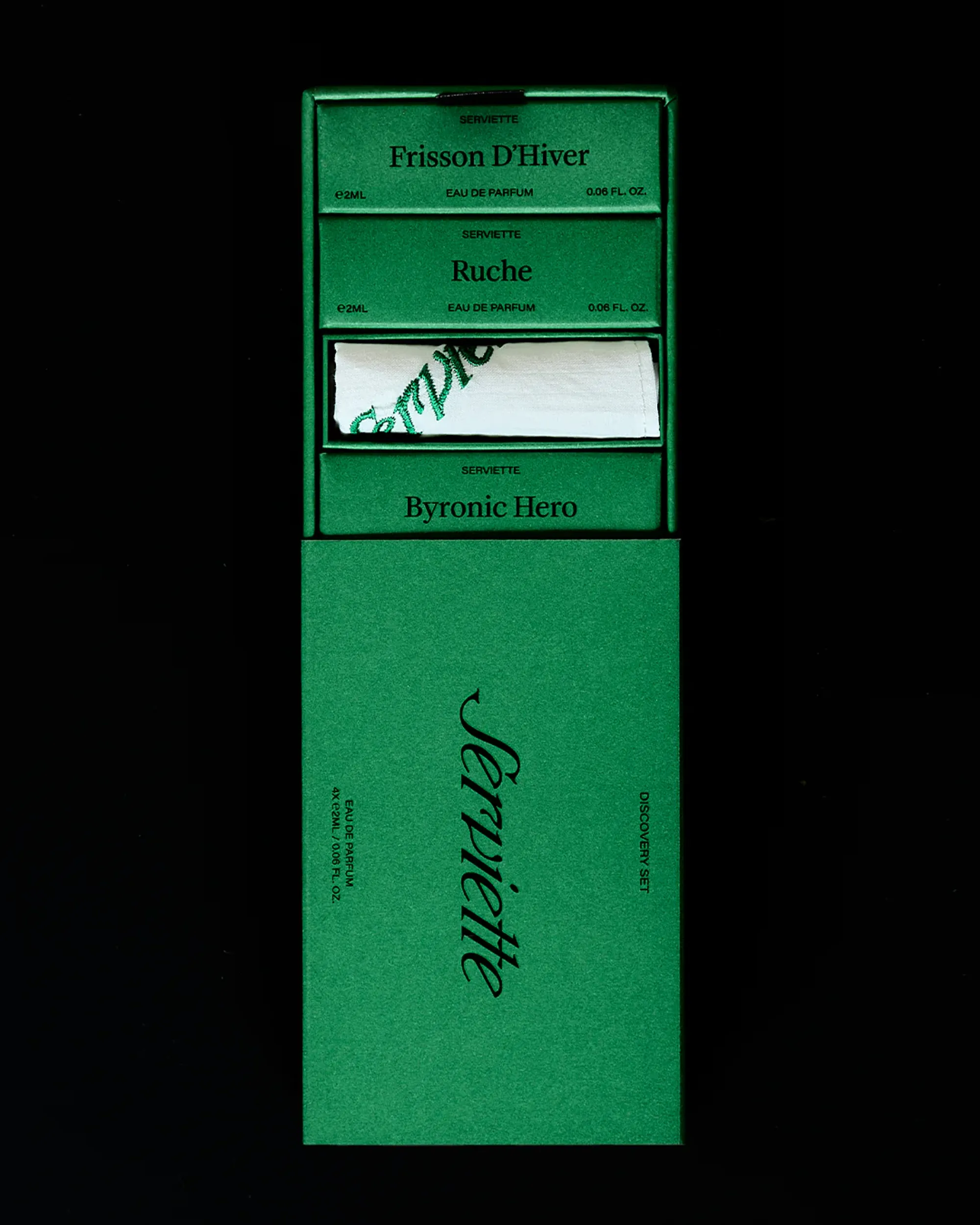
Serviette Discovery Set, including all four of his scents.
A Logo for a Brand That Doesn't Exist Yet
When did you decide to turn experimentation into an actual product?
I never imagined I'd have a brand. But my entire career has been spent storytelling - writing, interviewing people, so it felt like a natural extension.
Two friends, Ben and Alicia from Studio Select, said, "What if we create a logo for you?" I didn't have any idea at that point. They put together a logo and look, and I was like, “This is brilliant.”
The name wasn't there yet. When I tried to trademark my original idea, the word was too generic. So I landed on Serviette. It's a word I grew up saying; it means napkin in French. There's a book called Noblesse Oblige by Nancy Mitford with satirical essays about upper class versus lower class words. She argued that "serviette" was lower class, whereas "napkin" was upper class.
That's what I'm subverting: the word serviette today comes across as sophisticated, but I want to question those markers of so-called high society. It goes back to the power structure I was interested in, how taste gets dictated. For me, it's about making people more intellectually curious.
Loving Love Island Is Fine If You Know Where Reality TV Came From
You propose "a return to good taste." What's bad taste for you?
Bad taste, for me, is uninformed. I think you can be interested in mainstream or popular culture if you know where it came from and what led up to this point.
There's this sociologist, Pierre Bourdieu, who wrote a book called Distinction. It's about how certain things are seen as high or low taste and how that is learned through environment. For me, bad taste is when you don't have a basis for why something is good or bad.
Like, you can be a fan of Love Island, that’s completely fine. But if you know how reality TV started, why people were initially drawn to it, that changes things. There was this proto-reality show in America called An American Family, about the Loud family. The matriarch and patriarch announced their divorce while cameras were rolling, and it shocked America because it was a real couple on screen.
What I'm hoping for is that by being involved with Serviette, people become more curious about why they appreciate one thing over another.
The way it ties back to scent: regardless of your background, people spray something and immediately know if they like it or not. That's fascinating and worth dissecting because it has to do with where you grew up, what you were exposed to.
When people get into niche perfumery, they realize there's so much more to the tiny spectrum they saw at the Bloomingdale's counter. That's why it's important to expose yourself to as much culture and fragrance as possible.
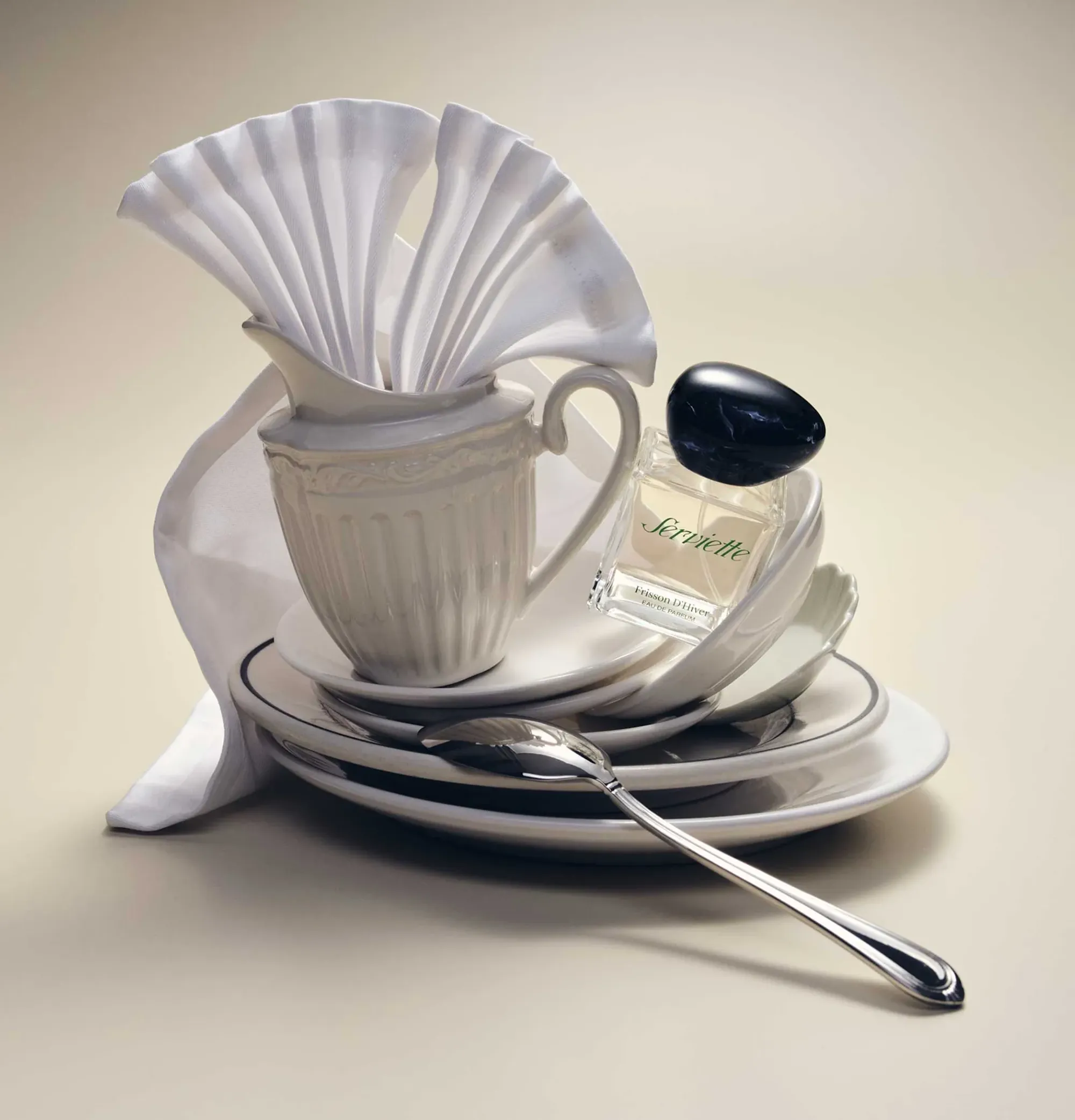
A visual from Serviette's current brand world.
Why a Napkin Matters More Than You Think
What's the story behind including an actual serviette in your packaging?
I have napkins lying around everywhere, including the embroidered ones I include in every bottle and discovery set.
Fragrance is the best thing to put on a serviette. Fabric is so porous that it holds fragrance incredibly well. Historically, fabric had a place in how people wore fragrance. In the Victorian age, people were afraid of foul odors outside, so they'd cover their nose and mouth with scented fabrics as protection.
Louis XIV was famously known as "the sweet flowery one." He would douse his clothes in rosewater. I want to challenge people to think about fragrance differently. You don't have to spray it directly on your skin. Maybe you spray your handkerchief and stick it in your pocket.
But I think the best thing to write on a napkin is a phone number. That goes very far, and it's charming. No one can recite a phone number anymore - you just bring up your iPhone. So yeah, give a little smooch on a napkin and write your phone number on it.
There's Never a Right Time to Start
Let's talk reality: What kind of capital did you need to launch?
I launched with about $30,000, which I'd spent years saving. I'm still fully employed at a marketing agency - that's my day job. Any time I could save a bit from a paycheck, I would. I also freelance, writing for magazines, so all those projects added to the pile. “That $30,000 was probably gone in a month of business.”
I don't know what number I'd recommend. For me, it was more: There's never a right time. You're never going to be fully ready. From all the advice I've read, everyone always says, "I wish I started earlier." Same. I wish I had started earlier.
It took me about five years to learn how to craft a formula that would work well and communicate what I wanted to. In a practical sense, I wish I could have started much earlier, but I realize that's not possible for most people.

A visual from Serviette's current brand world.
"Don't Ask, Don't Get" and why Gatekeeping Is Bullshit
Do you have a mentor guiding you through this?
I have friends in business - my peers - so we figure things out together. But there've been a couple people really instrumental: Brianna Lipovsky of Maison d’Etto, Jacob Winter who has Mush Studios, and Callum Rory Mitchell in Australia with PERDRISÂT. They helped me with things I didn't know I had to think about.
I'm the person who's like, “Don't ask, don't get.” I'm maybe a bit shameless in how I approach people. I'll be like, "Hey, can you tell me XYZ?" And luckily everyone has responded well.
Sometimes people in the perfume world can be protective. Historically, you cannot call yourself a perfumer unless you've gone to one of these five schools. I call bullshit on that. Let the customer decide. If I'm not a perfumer, fine.
The worst you hear is no, which is fine. It's actually been very surprising how often someone's been like, "I cannot help you, but I know someone who can."
Nobody Cares About Your Business More Than You Do
What's your biggest learning or advice for someone wanting to start their own brand?
One is practical: my biggest learning was having multiple shoots and assets available at launch. You need much more content ready than a single campaign.
I had photographer Tina Tyrell shoot the campaign, but if I'd only had that, after launch I'd be like, "Shit, now what?" Luckily, I had still life assets from Maxime Poiblanc, plus packaging and e-commerce shots. Having different looks allowed me to create a whole narrative at launch. You need way more than you think.
Philosophically: nobody cares about your business more than you do. As much as people offer help, at the end of the day you're the only person in the trenches.
It's both liberating and challenging. Liberating because you can do whatever you want - it's your brand. The challenging part is it's very isolating. There are days where I'm like, "Does the reward really outweigh the negative?"
Then you get that one comment or memory someone shares, and it’s like, "Okay, this is all worth it." Somebody gets what I'm trying to do here. Those are the times where I'm like, "This is working."